
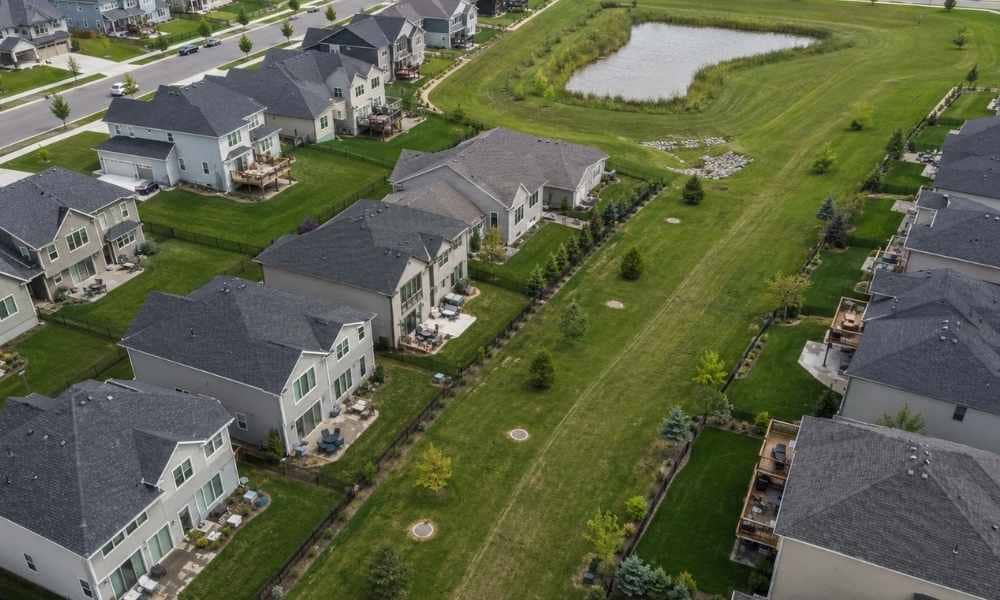
Kent County keeps growing. New neighborhoods are filling in fields and wooded lots that used to sit empty. That growth is good news for builders and homeowners, but it puts pressure on land that wasn’t built to handle it.
Streets can only carry so much. When a site’s drainage needs a path that streets and front yards can’t provide, engineers look to the back of the lot. That’s where rear-lot storm sewer easements come in.
A rear-lot easement gives underground pipes a straight, workable route through the middle of a block, often behind several homes at once. Done right, it stays out of the way. Done poorly, it turns into a headache for homeowners, builders, and the county for decades.
Good subdivision design plans for these easements early. It balances what a lot owner wants to do with their yard against what the pipe underneath actually needs.
Why Rear-Lot Storm Sewer Easements Appear in Modern Subdivisions
Not every storm sewer line can follow a street. Land slopes a certain way. Existing creeks and low points pull water in a direction that has nothing to do with where the roads sit. Sometimes the shortest, most gravity-friendly path to an outfall runs straight through the back half of a block.
Rear-lot easements solve this by letting a pipe cross several backyards in a row instead of bending around every curb and driveway. That straighter path often means fewer manholes, less pipe, and lower cost to build.
But a pipe running behind ten houses only works if it was planned before those houses existed. Once foundations, decks, sheds, and fences go in, moving a storm sewer line gets expensive fast. That’s why engineers try to lock in easement locations during the earliest design stage, right alongside street layout and lot lines.
When this happens early, the easement becomes a normal part of how the subdivision is shaped. It’s not something tacked on after the fact. It shows up on the plat, in the grading plan, and in what each future homeowner is told they can and can’t build in their own backyard.
How Subdivision Layout Decisions Affect Rear-Lot Sewer Access
Lot depth matters more than most buyers realize. A shallow lot with a rear easement leaves very little usable yard once the easement is marked off. A deeper lot can absorb that same easement without much complaint from the future owner.
Block length matters too. Longer blocks mean longer, straighter easement runs, which is often good for the pipe but can also mean more homes affected if something goes wrong underground.
Engineers also think about how a crew would actually reach the pipe if it needed a repair. Would a truck have to cross through a stranger’s fenced backyard? Is there a path from the street, or from a common area, that avoids that problem? These access questions shape where the easement sits and how wide it needs to be.
None of this works well if it’s decided after lots are already drawn. Easement placement needs to match the final plat before that plat gets recorded. A late change to the plat almost always means a late change to the drainage plan too, and that ripple slows everyone down.
Easement Width and Maintenance Considerations Developers Should Understand
An easement isn’t just a line on a map. It’s a working space. Crews need room to dig, room to park equipment, and room to move soil without damaging the pipe or nearby structures.
A few things shape how wide that space needs to be:
- Pipe size. A larger pipe usually needs more room around it for excavation and repair.
- Depth. A pipe buried deep in the ground needs a wider trench to dig safely, which pushes the easement width out.
- Soil and site conditions. Loose soil, high groundwater, or nearby slopes can all call for extra working room.
- Local review standards. Every municipality reviews easement widths a little differently, and the final number depends on what that jurisdiction requires for the project.
There’s no single width that fits every subdivision. Dimensions vary by county, by pipe type, and by site. What stays true everywhere is this: developers should treat the easement as permanently off-limits for anything solid. No sheds, no pools, no retaining walls, no mature trees planted right on top of the line. Those obstacles block repair crews and can cost a homeowner money later if the county has to remove them.
Common Rear-Lot Storm Sewer Easement Problems During Development Review
A handful of problems show up again and again during subdivision review, and most of them trace back to easements that weren’t planned early enough.
- Conflicts with home placement. A house, fence, or planned patio ends up sitting partly on top of the easement, forcing a redesign of the lot.
- Gaps between the recorded easement and what actually got built. The pipe shifts a few feet during construction, but the paperwork on file still shows the original line.
- Poor access for future repairs. Fences, retaining walls, or landscaping block the exact path a repair crew would need to use.
- Late-stage changes. A drainage issue turns up after lots are already platted and sold, forcing a costly redesign with unhappy homeowners involved.
Catching these problems during the review stage, before construction starts, is far cheaper than fixing them after homes are built. Once someone owns the lot, every change becomes a negotiation.
How Engineers Coordinate Rear-Lot Easements During Subdivision Design
Good coordination starts with a real look at the site itself, not just the paper plan. Engineers walk the land, check where water naturally moves, and study the slope before locking in a single lot line.
From there, the storm sewer route gets worked into the grading plan, the street layout, and the lot boundaries all together, rather than one after another. If the pipe needs to run behind six lots, that decision shapes how deep those lots are drawn and how the block gets divided.
The final plans need to show easement locations clearly, with widths and access points marked in a way that a reviewer, a builder, or a future homeowner can actually understand without guessing.
This kind of early coordination tends to move subdivision review along faster, since the county isn’t stuck waiting on last-minute changes. It also leaves the county with a neighborhood where storm sewer lines can be reached and repaired for years after the last house is finished, without anyone’s backyard turning into a construction site.