
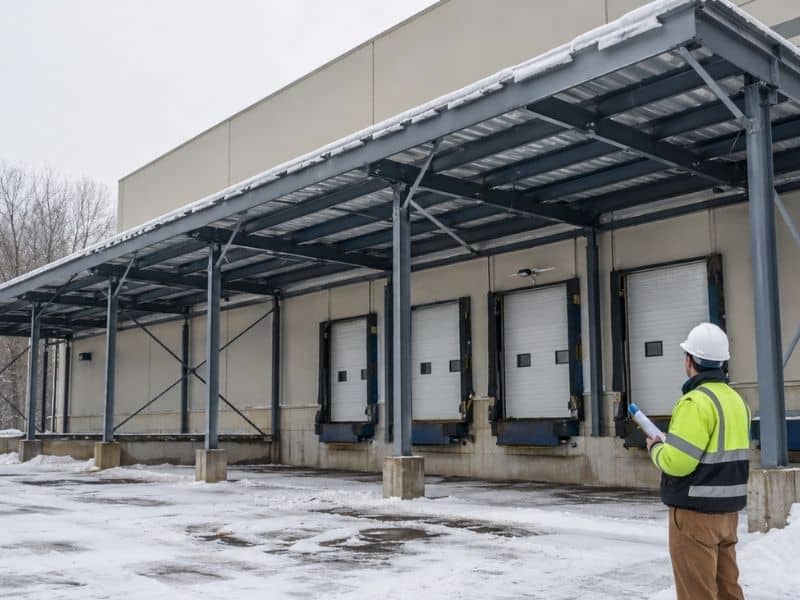
Grand Rapids winters are hard on loading canopies. Ice builds up, melts, and refreezes many times in one season. Over the years, this cycle can wear down small connection points that most people never look at closely.
How Repeated Freeze-and-Thaw Cycles Can Affect Canopy Connections
A loading canopy is only as strong as its connections. Bolts, welds, and brackets hold the whole thing together. When ice melts during the day and refreezes at night, water can slip into small gaps around these connection points. That water expands as it freezes. Over one winter, this may not matter much. Over several winters, it can add up.
Trapped moisture is often the real problem, not the ice itself. Water that cannot drain or dry out sits against steel and fasteners longer than it should. This does not mean damage is present. It means the areas deserve a look, especially on older canopies or ones with a history of drainage trouble.
Common factors a review may cover:
- Melting ice around bolted or welded joints
- Water that refreezes inside small gaps or seams
- Moisture trapped against steel due to poor drainage
- Connection points that see repeated wet-dry cycles each winter
No two canopies age the same way. A canopy near a downspout or a roof valley may take on more water than one with a clear, sloped drainage path.
Looking Beyond the Canopy Roof After an Ice Event
It’s easy to check the roof and call it done. But the roof is only one part of the picture. A full review usually looks at the whole structure, not just the surface people can see from below.
Areas often included in a review:
- Supporting steel and framing under the roof deck
- Attachment points where the canopy connects to the main building
- Columns that carry the canopy’s weight down to the foundation
- Bracing that keeps the frame steady in wind and snow
- Drainage paths, including gutters, scuppers, and downspouts
- Any visible bending, twisting, or shifting in the frame
Ice does not always show its effects where it lands. A heavy buildup on one section of roof can push stress into a column or brace several feet away. That’s why a walk-around inspection alone often is not enough. Someone trained to read structural steel needs to look at how the pieces work together.
When Ice Buildup Changes How a Loading Canopy Carries Weight
Every structure is built to carry a certain amount of weight. Ice adds weight the canopy was not necessarily sized for on a normal day. A few inches of ice across a large roof section can weigh more than most people expect.
Uneven buildup matters too. Wind and drainage patterns rarely spread ice evenly across a canopy. One side might carry a light dusting while the other carries a thick sheet. That kind of imbalance can twist a frame in ways that even loading was never meant to handle.
This is where a structural engineering review earns its place. It’s not a generic checklist. The canopy’s actual size, span, connection type, and age all factor into how much load it can safely handle, and how that load behaves when it’s uneven. A canopy built in 1995 with a shorter span will not respond to ice the same way a wide, newer canopy will.
Separating Cosmetic Damage From Structural Warning Signs
Not every mark on a canopy means trouble. Paint chips, minor rust spots, and small dents are usually cosmetic. They’re worth watching but rarely urgent.
Some signs are different. These deserve a prompt look from a professional:
- Noticeable sagging in the roof line or beams
- Bolts, plates, or brackets that have shifted or pulled loose
- New cracks forming at connection points
- Bent, buckled, or missing bracing
- Loading dock doors or equipment nearby that stick, bind, or stop working right
That last point catches people off guard. A door that suddenly won’t close all the way, or a dock leveler that starts sticking, can point to a frame that has shifted just enough to throw things out of alignment. It’s worth a second look, even if the canopy itself looks fine at first glance.
Planning Repairs Without Losing Loading-Dock Access
A loading dock rarely gets to sit idle during repairs. Deliveries keep coming. Tenants still need access. This is often the real challenge, more than the repair work itself.
A structural engineer can help sort out what needs attention first and what can wait. Not every repair carries the same urgency. Some can be scheduled around normal operations. Others need barriers or temporary support right away while a full plan comes together.
Before work begins, it helps to record current conditions clearly: photos, measurements, and notes on where stress or movement shows up. This gives the repair crew a clear starting point and gives the property owner a record of what was found and why certain work was chosen.
Coordinating with dock staff and tenants early on tends to save time later. Knowing which bays need to stay open, when trucks typically arrive, and where staging space is available lets a repair plan work around daily operations instead of against them. A canopy repair does not have to mean a shutdown. With the right plan, most loading docks stay open through the process, with only short, well-timed closures where truly needed.