
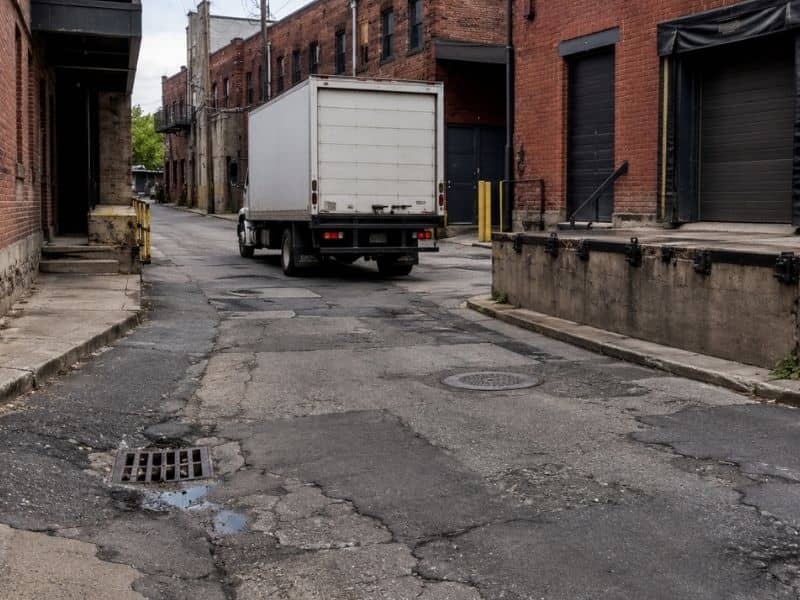
Freight alleys don’t get much attention until something goes wrong. A truck can’t turn. A loading dock backs up traffic. Pavement breaks apart under repeated weight. When owners plan to rebuild one of these alleys, a roadway engineer looks past the surface and figures out what the corridor actually needs.
What Makes a Freight Alley Different From an Ordinary Street?
A neighborhood street mostly carries cars, bikes, and the occasional garbage truck. A freight alley carries something else: box trucks, delivery vans, tractor-trailers, and forklifts moving in and out of loading bays, day after day.
That repeated heavy use changes what the pavement, curbs, and turning space need to handle. A street built for light traffic can look fine on the surface while quietly failing under freight loads it was never built to carry.
This is where a roadway engineer comes in. Their job is to look at how the alley is actually used, not how it was originally built, and figure out whether the current layout can still support that use.
Grand Rapids has a long industrial past. Old furniture factories, warehouses, and rail-adjacent buildings still line parts of the city, especially on the West Side. That history doesn’t mean every alley near these buildings was built for today’s freight vehicles. Many were laid out decades before modern trucks existed. A proper review treats each alley as its own case, not an assumption based on the neighborhood around it.
How a Roadway Engineer Reads the Existing Alley Before Reconstruction
Before anyone talks about new pavement or a redesigned layout, the engineer needs a clear picture of what’s already there. This step gets skipped more often than it should, and skipping it causes problems later.
A field review typically covers:
- Pavement edges and how far they’ve shifted or crumbled over time
- Drainage inlets and whether water is pooling or draining as intended
- Curb height, wear, and damage from repeated vehicle contact
- Utility covers, vaults, and access points that sit within the alley
- Grades and slope, especially near loading docks and building entrances
- Tight turns, narrow points, or other unusual geometry
Older industrial corridors rarely stay the same over the decades. Utility lines get added. Pavement gets patched. A loading dock gets modified. None of that always shows up on a single site visit, which is why a careful physical review matters more here than on a newer street. The goal is simple: know what’s actually there before deciding what to change.
Where Freight Movements Expose Problems Ordinary Traffic May Not
Cars are forgiving. They’re small, they turn tightly, and they don’t need much room to back up or park. Trucks are a different story, and that’s exactly where alley problems tend to surface.
A delivery truck making a wide turn into a narrow alley can clip a curb or a building corner that a car would clear without trouble. A tractor-trailer backing into a loading dock needs room most alleys were never built to offer. Repeated turning in the same tight spot wears down pavement edges and curbs faster than regular traffic would.
A roadway engineer looks at how freight vehicles actually move through the alley, whether from direct observation, driver input, or records of past incidents. That real movement pattern, not a general assumption about “trucks,” points to specific reconstruction needs. Claims about exact truck sizes or a known problem on a particular Grand Rapids alley should come from real, project-level evidence, not guesswork.
How an Engineer Balances Reconstruction With the Existing Industrial Fabric
Rebuilding a freight alley isn’t like building one on open land. The buildings, loading docks, lot lines, and fences around it are already there, and most aren’t moving.
That limits what a reconstruction project can do. A wider turning radius might sound good on paper, but if it means cutting into a building foundation or an adjoining property, it’s not on the table. A roadway engineer works within those fixed points rather than around them, which is why alley reconstruction usually looks more like careful problem-solving than a clean redesign.
Grand Rapids’ industrial and railroad history helps explain why some corridors are shaped the way they are. City planning and preservation records describe how furniture manufacturing and rail lines shaped development on the West Side and other industrial areas, with buildings and access points laid out to suit factory operations of their time. That history is useful context, not a reason to assume every corridor was planned around today’s freight equipment. This isn’t a question of historic preservation policy, just a practical reality an engineer works around.
What a Roadway Engineer Should Document Before the Reconstruction Moves Forward
Good reconstruction decisions need a clear technical record: what the alley looked like before work started, what it’s meant to carry, what limited the design choices, and why specific choices were made.
That record does more than sit in a file. It gives owners, contractors, and city reviewers a shared understanding of the project. If a question comes up during construction, or years later when another change is on the table, the record explains the reasoning instead of leaving people to guess.
Putting this together means pairing field observations with design notes in a way that stays practical, not turning the project into a stack of forms. The right level of detail depends on the project’s size and who needs to use the record later.
There’s no single fix for every freight alley. The right reconstruction approach depends on the actual corridor: its condition, the vehicles that use it, the buildings around it, and the rules the city applies to that site.