
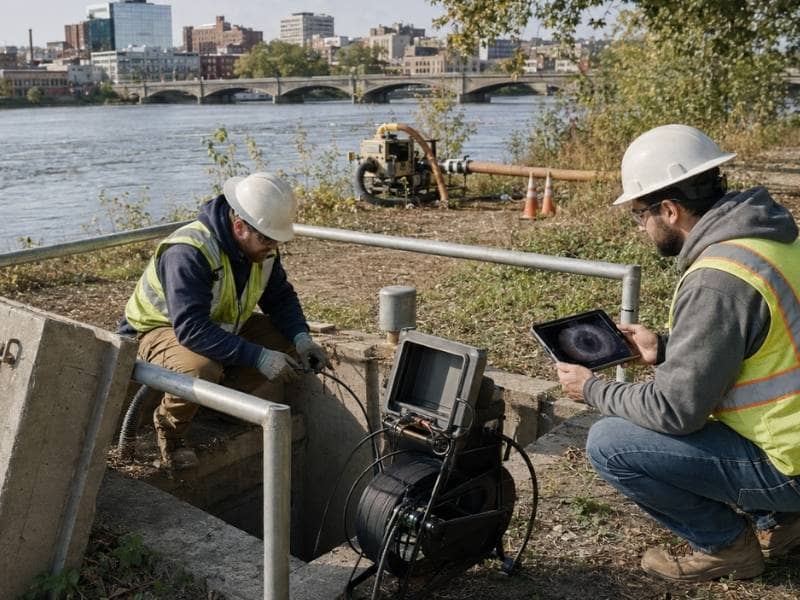
A river siphon carries a pipeline under a waterway. In Grand Rapids, these crossings sit beneath the Grand River and its tributaries. Fixing one is not like fixing a straight run of pipe in a yard. The pipe drops below the riverbed, holds that depth, and comes back up on the other bank. Pipeline engineering for this kind of crossing looks at the whole system together, not as a set of separate repairs.
Reconstruct the Siphon Profile When the Riverbed Is Inaccessible
Old drawings show where the pipe was supposed to go. They don’t always show where it actually sits now. Rivers shift. Pipes settle. Past repairs get added without the plans being updated to match.
A pipeline engineer starts with what’s on record: as-built drawings, permit files, older inspection notes. Then the engineer checks that record against what can be measured in the field. That might mean tracing the pipe with a locator, checking elevations at each access point, or running a camera or sonar tool through the line to find the low point under the river.
The goal is a real profile: actual depth, actual invert elevations, actual location of every bend and access point. Skipping this step causes problems later. A liner sized for the wrong slope won’t sit right. A repair planned around the wrong depth can miss the damage by several feet. Check first. Design second.
Separate Hydraulic Restrictions From Structural Deterioration
A siphon that isn’t moving water the way it used to can have more than one cause. Sediment can pile up at the low point and choke the flow. Corrosion can eat away at the pipe wall from the inside. Joints can shift out of alignment. The pipe itself can sag lower than it was built to sit.
These problems can look alike from the outside. A drop in flow, backups upstream, or slow drainage might point to a blockage, or it might point to a structural problem that’s letting sediment collect in a low spot that shouldn’t exist in the first place.
The U.S. EPA lists deposits, corrosion, leakage, joint defects, and pipe sags among the most common problems found in sewer pipes. Sorting out which one is happening, or whether more than one is happening at once, takes actual eyes on the pipe: CCTV inspection, sonar in flooded sections, or physical sampling of the pipe wall. A cleaning job won’t fix a sag. A structural liner won’t clear a sediment blockage on its own.
Calculate What a Rehabilitation Liner Does to the Effective Pipe Diameter
Lining a pipe from the inside fixes the structure, but it also makes the pipe smaller. Sliplining, cured-in-place pipe, and other lining systems all add wall thickness. That thickness eats into the space the water flows through.
For most pipes, a little lost diameter doesn’t matter much. For a river siphon, it can. These crossings already sit at a low point in the system and often carry flow near full capacity during storms. A liner that shrinks the inside diameter by even half an inch can change how much water the siphon can carry during a peak flow event.
A pipeline engineer runs the numbers before picking a liner: the new inside diameter, how the liner’s surface compares to the old pipe, and how that combination performs against the flow the siphon needs to carry. A smoother liner can sometimes offset some of the lost space, but that has to be checked against the specific material and flow number. It shouldn’t be assumed.
Build the Isolation Strategy Around the Actual Barrel Configuration
Taking a siphon out of service to repair it is not simple. The pipe carries flow that has to go somewhere while work is underway.
Some siphons have one barrel, meaning one pipe carries all the flow. Others have two or more barrels running side by side. On paper, a second barrel looks like a backup. In practice, that only holds true if the second barrel is in working condition and the valves or gates needed to route flow into it still work.
Before setting a shutdown plan, an engineer checks the isolation structures at each end of the siphon: gates, valves, weirs, or diversion chambers. The engineer also looks at whether upstream storage, like a wet well or a stretch of larger pipe, can hold flow long enough to do the work. If neither barrel redundancy nor storage is available, the plan may need a temporary bypass line with pumps running above ground for the length of the repair.
Check External Pressure and Riverbank Transitions Before Selecting a Repair System
A pipe under a river deals with forces that a pipe in an open field doesn’t see as much.
When a siphon is drained for inspection or repair, the empty pipe can face pressure from groundwater pushing in from outside. If the soil around the pipe isn’t giving enough support, that outside pressure can crush or deform a pipe that wasn’t built to handle it while empty.
Cover over the pipe changes too, deeper under the middle of the river, shallower near each bank. Right at the riverbank, the pipe moves from one kind of soil support to another, and that’s often where stress shows up first, as settlement, cracking, or joint separation.
These conditions shape what kind of repair makes sense. A liner might fix the pipe wall but not a settlement problem near the bank. A localized repair might work for one damaged section but not for a pipe under pressure along its full length. In some cases, replacing a segment is the better choice.