
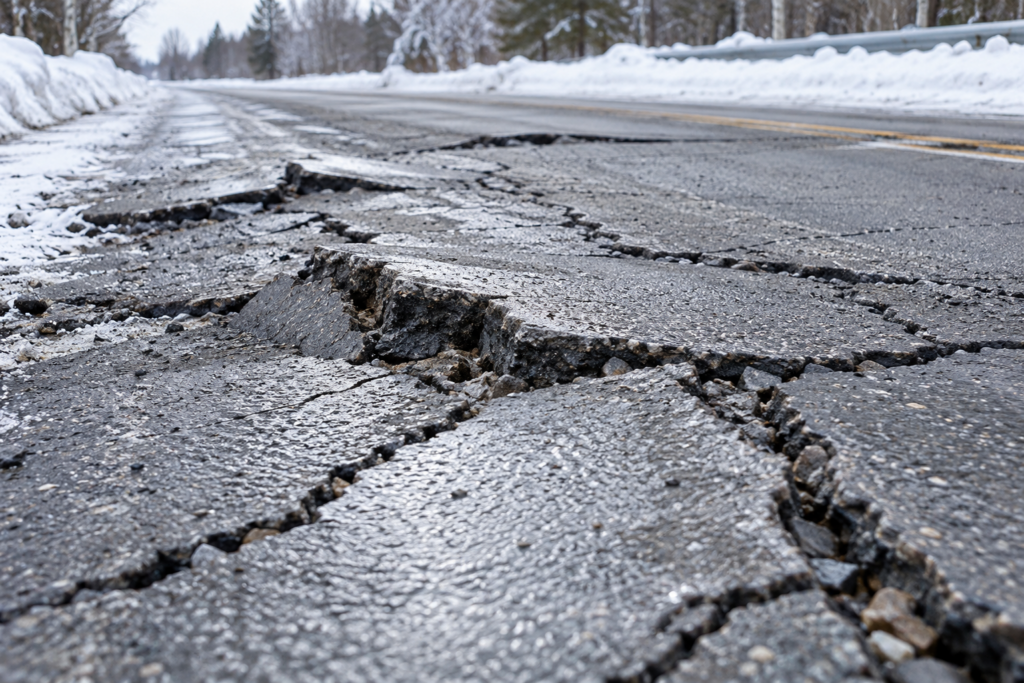
A parking lot that looked fine in October can open up by March. Bumps rise across drive aisles, cracks spread from curb lines, and soft spots break apart under truck traffic as the ground thaws. When the pavement is only a few years old, owners often want to know who’s responsible. An engineering expert witness can trace the damage back to its cause and give property owners, contractors, designers, and insurers a clear, evidence-based answer.
How Frost Heave Causes Pavement Damage and Structural Movement
Frost heave is the upward movement of soil caused by ice forming underground during freezing weather. As the freezing front moves down, water in certain soils gets drawn toward it and freezes into layers called ice lenses. Those lenses grow and push the ground, and the pavement on top of it, upward. Heave is often uneven, which is why it creates humps, cracks, and tilted slabs instead of a smooth rise.
The damage often gets worse during the thaw. Ice lenses melt from the top down, leaving extra water trapped in the soil above still-frozen ground. That saturated layer loses much of its strength, so traffic loads can rut, crack, or punch through the pavement. Engineers call this thaw weakening, and it can be more destructive than the heave itself.
Frost movement can affect more than pavement. Curbs, sidewalks, light pole bases, drainage structures, and slabs near buildings can shift too. Those secondary effects often show up in the same claim.
Soil Conditions and Drainage Problems Behind Frost Heave
Frost heave generally needs three things at once. The soil has to be frost-susceptible, freezing temperatures have to reach it, and water has to be available. Remove any one of those, and heave usually drops sharply. That’s why soil conditions and drainage sit at the center of most investigations.
Silty soils are among the most frost-susceptible because they hold water and move it upward through small pores. Some clays and fine sands with high silt content can also heave. Clean, well-graded gravels and coarse sands tend to resist it because water drains through them quickly. Laboratory tests on particle size and fines content help classify how susceptible a soil is.
Water supply often turns a minor problem into a major one. High groundwater, poor surface drainage, clogged underdrains, leaking utilities, and downspouts that discharge onto pavement can all feed ice lenses. Grading that sends water toward pavement edges or traps it in low spots adds risk. An investigation that ignores drainage will likely miss part of the story.
Evaluating Pavement Design, Materials, and Construction Practices
Pavement design in cold regions usually considers frost. Common approaches include placing enough non-frost-susceptible base and subbase material, removing problem soils, adding drainage layers or underdrains, or using insulation in special cases. The right approach depends on the climate, soil conditions, traffic loads, groundwater, and budget. No single design method fits every site.
Materials matter as much as thickness. A base course specified as free-draining can fail if the delivered aggregate contains too many fines. Contaminated base, mixed with subgrade during construction, can also become frost-susceptible. Material testing records and samples taken from the site help show whether the materials matched the specifications.
- Whether unsuitable soils were removed or left in place.
- Whether compaction met project requirements, based on test records.
- Whether underdrains, edge drains, and outlets were installed and connected.
- Whether grading matched the plans and directed water away from pavement.
Construction records, inspection reports, and as-built drawings often reveal gaps between the design and the finished work. Those gaps can carry significant weight in a claim.
How Expert Witnesses Investigate Frost Heave Pavement Claims
An expert witness in these cases is usually a licensed geotechnical, civil, or pavement engineer with experience in cold-weather performance. The investigation starts with a site visit to map the damage, including cracks, heaved areas, ruts, and drainage problems. Photos and elevation measurements create a record of current conditions. Patterns often point toward specific causes, such as heave following a utility trench or a poorly drained edge.
Soil testing usually comes next. Borings, test pits, and pavement cores reveal the actual layer thicknesses, base quality, and subgrade soils. Laboratory soil testing measures moisture content, particle size distribution, and fines content to help identify frost-susceptible materials. Groundwater observations also help determine whether enough water was available to feed ice lenses.
The expert then reviews documents. Plans, specifications, geotechnical reports, submittals, test results, inspection logs, and maintenance records all help build the timeline. Weather data, such as freezing index records, show how severe the winter was compared to typical conditions. A harsh winter can expose weaknesses, but it doesn’t automatically excuse poor design or construction.
Determining Liability, Repair Costs, and Long-Term Prevention
Liability often depends on where the failure started. A design that didn’t account for known frost-susceptible soils points one direction. Construction that departed from the plans, or used out-of-spec materials, points another. Poor maintenance, such as blocked drains or ignored cracks that let water in, can also play a role. Many claims involve more than one contributing factor.
The expert’s report explains these causes and how much each one likely contributed. Courts and adjusters generally look at whether the work met the applicable standard of care, which is the level of skill a reasonable professional would use in similar circumstances. Clear documentation and sound reasoning make the findings easier to rely on. Legal questions about responsibility should be discussed with an attorney.
Repair costs depend on the root cause. Surface patching rarely fixes frost damage for long. Lasting repairs may require removing frost-susceptible soils, rebuilding the base, improving drainage, or correcting grading. Prevention on future projects starts with a good geotechnical investigation, frost-aware pavement design, careful material control, and routine drainage maintenance.
Frequently Asked Questions
What does an expert witness do in a frost heave claim?
An expert witness investigates why the pavement failed. They inspect the site, test soils and materials, and review design and construction records. They then explain the cause in a written report. They may also testify in depositions or at trial.
Can frost heave be prevented in pavement design?
Frost heave risk can often be reduced through design. Common steps include using free-draining base materials, removing problem soils, and adding drainage. The right approach depends on soil conditions, climate, and budget. A geotechnical investigation helps guide those choices.
Is frost heave damage the contractor’s fault?
Not always. Damage can result from design choices, construction practices, material problems, maintenance, or unusual weather. Often several factors contribute. An engineering investigation helps identify which ones played a role.